My morning cranking the Babbage Difference Engine
In January 2016 I went through the training to become an operator of the Computer History Museum's Babbage Difference Engine. There are two Babbage Difference Engines, and at that time one was in the Museum in Mountain View, CA. There is a lot of information on the Engine itself at http://ed-thelen.org/BabInstCHM/index.html. We trainees had a morning of presentations on it, mostly covering practical aspects of the running of the machine. This was followed by a few hours of hands-on training. Pairs of us were assigned half-day slots where a custodian would show us how exactly we were to stand on the side of the machine and crank its big handle.
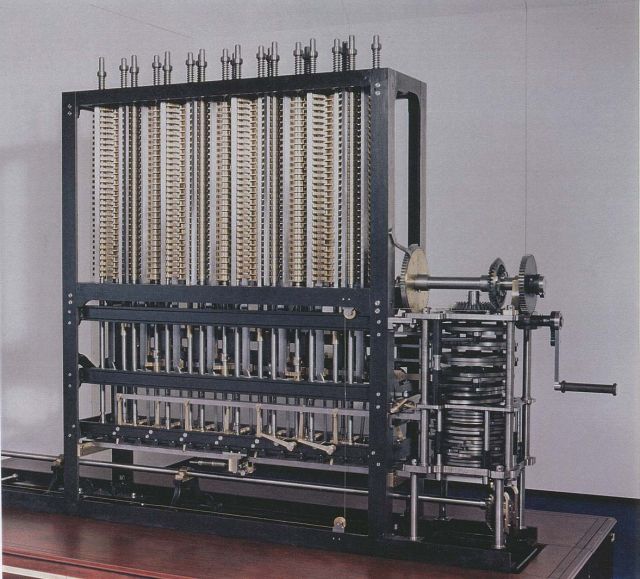
It's a pipelined adding machine. Gears represent the decimal numbers, and more gears do addition. All the energy for this action comes from a human winding the big crank on the right. But the Engine is a temperamental thing, and it has to be turned just right or you will smash it. The custodian made this crystal clear to us at the beginning of the lesson. Parts smashed by earlier operators were shown.
Then after a couple of demonstrations, we were invited to turn the handle.
What does cranking feel like? Imagine that you are pushing a big, heavy roller over a rough landscape.
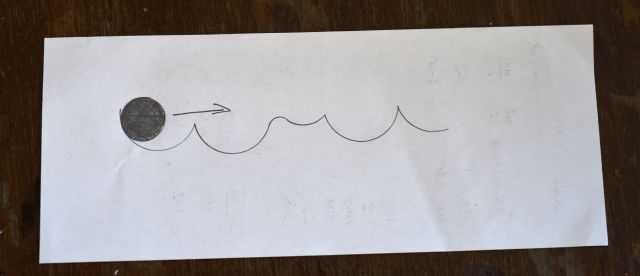
Your job is to push it at just the right speed so that it gets over the peaks, but not so fast that it ever leaves the surface. A single loss of contact and the machine will miss a state, and probably jam. A failure to crest a peak is a stall, and the resulting backwards movement will also likely cause a jam.
"But surely," I hear you ask, "this machine operates in the perfect realm of mathematics, what could possibly make the landscape bumpy?" Partly the huge number of slightly irregular gears all meshing together. But in large part it is 210 of these, whirring and clicking away:
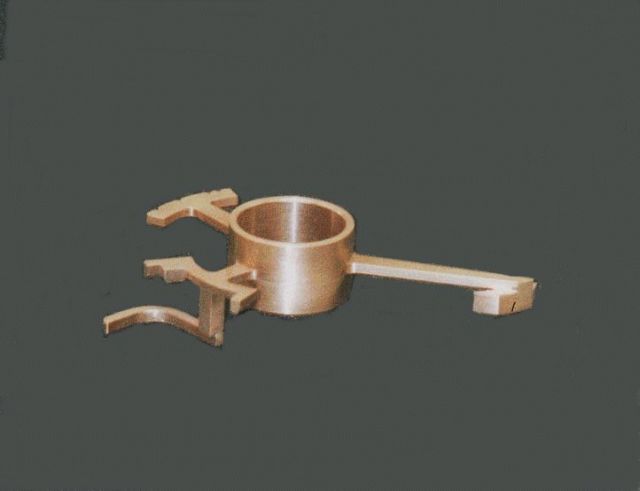
They are the carry levers. Every time there is a carry-out from any of the decimal places, they physically propagate the carry to the next digit. Because the engine is continuously adding decimal numbers together, there is a complicated pattern of carries happening all the time. This accounts for a lot of the variability in effort. A machine set up to roll over from all-9s to all-0s would probably fail.
By the end of the morning my cranking technique, speed, and vigilant demeanor had been deemed adequate by the custodian, and I was invited to schedule the final qualification test. Sadly the Difference Engine left the Computer History Museum shortly afterwards, so I never got to start in my role as twice-a-month crank operator.
In all the experience really really made me appreciative of the thing that we take for granted: computing based on electrical potentials -- voltage. This machine was all about momentum. It cannot simply stop and start. Now, every time a device hits a halt and goes from millions or billions of hertz to zero instantaneously, I'm grateful that we've invented computing machinery with no moving parts. Until I'd experienced the alternative, this wonderful discovery went unnoticed.
Thanks for reading the Excamera Labs newsletter. If you like it, please forward it and encourage others to subscribe.